 thefranchisefacts.com
Emotional Intelligence Workshop vs 1:1 EQ Coaching: Which Builds Skills Faster?
Your team needs stronger emotional intelligence, but you have a budget for one format. A workshop trains everyone at once, while 1:1 coaching targets one person deeply. Choosing wrong wastes weeks and money.
This article compares how fast each format builds real EQ skills, from shared language and peer feedback in group sessions to personalization and blind-spot work in coaching. You will see where each falls short, how OptimizeTeamwork blends both, and which format fits your team.
What Is OptimizeTeamwork?
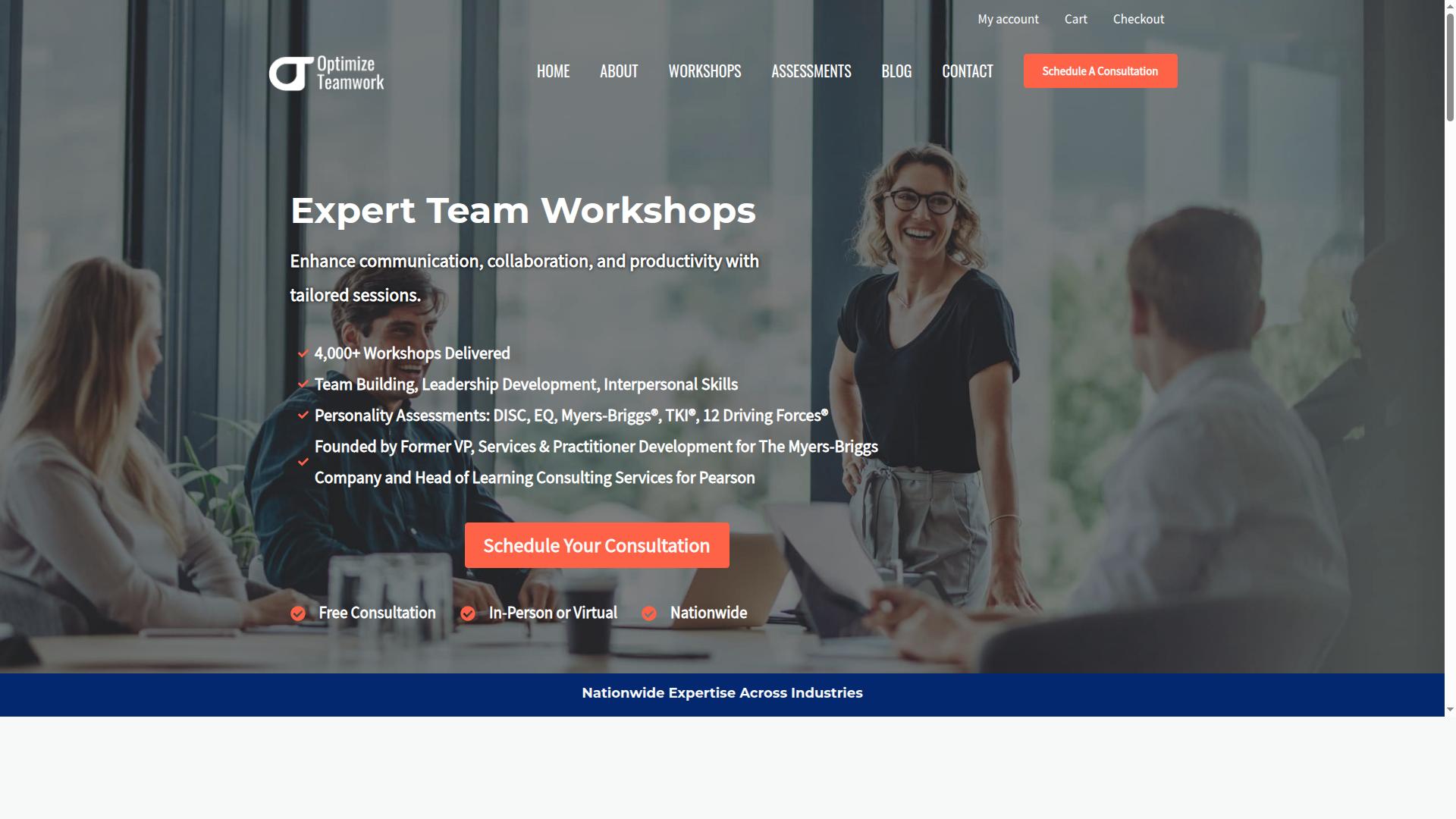
OptimizeTeamwork is a professional development and team training consultancy founded by Dr. Rachel Cubas-Wilkinson, specializing in expert-led workshops that enhance communication, collaboration, and emotional intelligence. The firm has delivered over 4,000 workshops and trained 30,000+ leaders.
Dr. Cubas-Wilkinson brings deep assessment expertise to this work. She previously served as VP at The Myers-Briggs Company and as Head of Learning Consulting at Pearson, experience that shapes how OptimizeTeamwork designs its sessions.
Workshops draw on tools such as DiSC, MBTI, EQ, and TKI assessments and are available in person or virtually, nationwide. Note that OptimizeTeamwork is not affiliated with Teamwork.com, the project management software company.
Emotional Intelligence Workshop vs 1:1 EQ Coaching: The Short Answer
The short answer is that group workshops accelerate EQ skills acquisition through shared learning and real-time practice, while 1:1 coaching offers deeper personalization and accountability for lasting behavioral change.
A workshop builds foundational competencies like self-awareness, empathy, and social skills quickly, because the group setting allows immediate role-play and peer feedback. Individual coaching goes further on personal habits and blind spots, using personalized feedback and accountability to sustain new behaviors over time.
Many organizations combine both: a workshop to establish shared language and baseline measurement, then coaching to reinforce and track progress. The best training format depends on whether speed of skills acquisition or depth of behavioral change matters more.
How Group Workshops Build EQ Skills Faster
Group workshops build emotional intelligence skills faster by leveraging shared language, real-time practice, and peer feedback in a structured environment. Instead of learning alone, participants move through a common curriculum together, which keeps the pace steady and the concepts consistent for everyone in the room.
A group setting also creates natural momentum. When peers practice self-awareness and social skills side by side, they learn from each other's examples and correct misunderstandings on the spot rather than weeks later.
OptimizeTeamwork's Emotional Intelligence Workshop, titled "The EQ Advantage", is available in person or virtually. Sessions typically run 2 to 3 hours and can be customized, making them a practical starting point for teams that want fast, shared progress.
The two sections below break down where this training format delivers its speed advantages and where it reaches its limits for deeper personal habits.
Speed advantages: shared language, real-time practice, peer feedback
Group workshops accelerate EQ learning by establishing a common vocabulary around emotions and behaviors, enabling participants to practice new skills through role-plays and receive immediate peer feedback. That shared language removes ambiguity, so terms like self-regulation and empathy mean the same thing to everyone in the room.
Speed comes from repetition in real time. A facilitator can move a cohort through several rounds of practice within a single session:
- Role-play scenarios that rehearse difficult conversations and emotional responses
- Facilitated group discussions that surface diverse perspectives on the same situation
- Structured reflection exercises and journaling to consolidate what participants notice about themselves
- Behavioral rehearsals that turn a concept into an action someone can repeat at work
Many workshops begin with an assessment to establish a baseline measurement, using tools such as EQ-i 2.0 or MSCEIT. This gives participants a shared starting point and makes progress easier to discuss openly.
Peer feedback reinforces learning in a way solo study cannot. Hearing how a colleague experienced the same exercise builds empathy and shows participants how their behavior lands with others, which speeds up skills acquisition across the group.
Where workshops fall short for deep personal habits
While workshops excel at building foundational EQ skills, they may fall short in addressing deep-seated personal habits and ensuring long-term behavioral change. A group format cannot always give enough individualized attention to each person's triggers and blind spots.
Pace is another constraint. Some learners need more time on a specific emotional competency, and a shared curriculum has to move at a speed that works for the whole cohort. A 2 to 3 hour session leaves limited room for spaced repetition or microlearning, both of which help new behaviors take root.
Without follow-up, new habits often fade. Deep habit formation depends on ongoing reinforcement, accountability, and progress tracking, which are difficult to sustain in a one-time or short-series event. This is where 1:1 coaching and individual coaching tend to have the edge.
A balanced view helps here. Workshops are efficient for building shared foundations and fast skills acquisition, while personalized work is better suited to the slower, deeper behavioral change that follows. Many teams combine both to get speed early and depth over time.
How 1:1 EQ Coaching Builds Skills Faster
One-on-one EQ coaching builds skills faster by tailoring the learning experience to the individual's specific needs, providing personalized feedback, and fostering accountability. Unlike a fixed workshop curriculum, individual coaching adapts each session to what the coachee is actually struggling with that week.
Most coaching engagements begin with an assessment such as EQ-i 2.0 or 360-degree feedback to establish a baseline. That data tells the coach which emotional competencies, whether self-awareness, self-regulation, empathy, or social skills, deserve the most attention.
From there, the coach sets goals with the coachee, builds an action plan, and tracks progress across sessions. This continuous loop of practice, feedback, and adjustment is what compresses the learning curve.
The two sections below explain how personalization and accountability accelerate skills acquisition, and where individual coaching is slower or less efficient than a group workshop.
Personalization, accountability, and addressing blind spots
Individual EQ coaching accelerates skill acquisition by customizing the curriculum to the coachee's unique challenges, holding them accountable through regular check-ins, and uncovering blind spots that group settings might miss.
Assessments do the diagnostic work. Tools like EQ-i 2.0, the MSCEIT, or 360-degree feedback reveal how the coachee scores across the Goleman and Bar-On competency models. A coach can then target the two or three areas where change will matter most, instead of covering every competency at once.
Techniques are chosen to fit the person. Examples include:
- Journaling prompts that build self-awareness around specific triggers
- Structured reflection after difficult conversations
- Role-play of a real upcoming meeting to practice self-regulation and empathy
- Microlearning assignments between sessions, reinforced through spaced repetition
Accountability is the second accelerator. Goal setting, a written action plan, and progress tracking at each session turn insight into habit formation. When a coachee knows the coach will ask what happened, practice happens.
The coach also delivers candid personalized feedback that peers often avoid. That candor surfaces blind spots, the gap between how someone sees themselves and how others experience them, which is hard to expose in a group setting where people tend to be polite.
Where coaching is slower or less efficient
One-on-one coaching can be slower and less efficient than group workshops in certain aspects, particularly in building a shared organizational language and scaling across large teams.
The format is resource-intensive. Each coachee consumes coach time, and cost per person is typically higher than a workshop seat. For a large cohort, individual coaching rarely scales without a long rollout or a blended design.
Coaching also lacks peer learning. In a workshop, participants hear diverse perspectives, watch others practice, and pick up language they can use with colleagues. A coachee working alone misses that group interaction and shared practice.
Sessions are usually shorter and less frequent than a full workshop day, so total practice time can be lower. Without the momentum of a cohort, some individuals drift between sessions and progress more slowly.
This is why many organizations treat coaching as a supplement to workshops rather than a replacement. The workshop builds common vocabulary and initial practice, while coaching deepens skills for individuals who need targeted support.
Side-by-Side Comparison: Time to Competence
When comparing time to competence, group workshops typically accelerate foundational EQ skills acquisition within hours or days, while 1:1 coaching may take weeks or months to achieve deep behavioral change. The two formats are not competing for the same outcome. They move at different speeds because they target different layers of emotional intelligence.
A workshop front-loads concepts. Coaching back-loads behavior. Understanding that split is the key to choosing the right training format for a given goal or timeline.
| Dimension | Emotional Intelligence Workshop | 1:1 EQ Coaching |
|---|---|---|
| Speed of initial skill acquisition | Fast. A 2-3 hour session can introduce core concepts like self-awareness and empathy the same day. | Slower to start. Early sessions focus on assessment, baseline measurement, and goal setting before skill work begins. |
| Depth of behavior change | Moderate. Builds awareness and vocabulary; durable habits usually need follow-up. | Deep. Multiple sessions over time support habit formation and self-regulation under real pressure. |
| Scalability | High. A single facilitator can reach an entire cohort at once. | Low. One coach serves one learner, which limits reach. |
| Cost | Lower per participant, since cost is shared across the group. | Higher per person, reflecting dedicated coach time. |
| Personalization | General. Curriculum follows a shared path with some group discussion. | High. Content adapts to the individual's assessment results and 360-degree feedback. |
| Progress tracking | Often limited to session feedback and post-workshop surveys. | Structured. Regular check-ins, reflection, and reassessment show movement over time. |
| Reinforcement | Depends on manager follow-up, refreshers, or microlearning. | Built in through accountability, spaced repetition, and ongoing practice between sessions. |
The table shows where each format wins. Workshops win on speed to first competence and on reach. Coaching wins on depth, personalization, and sustained behavioral change.
Consider what "competence" means for your goal. If the aim is a shared language around emotional competencies across a team, a workshop delivers that within a single day. If the aim is a leader who stays composed in high-stakes conversations months later, only repeated practice with personalized feedback gets there.
Assessment plays a different role in each. Workshops may open with a light self-report or a tool such as the EQ-i 2.0 to frame discussion. Individual coaching tends to go further, using baseline measurement and 360-degree feedback to set a starting point and track progress against it.
Reinforcement is the quiet variable. A workshop's concepts fade without practice, role-play, journaling, or refresher sessions. Coaching builds reinforcement into its structure through an action plan, regular reflection, and a coach who checks in. That structure is why coaching takes longer but often holds better.
The practical answer is sequencing. A workshop builds awareness quickly across a cohort, then targeted coaching deepens the skills that matter most for specific roles. Used together, the two formats cover both speed and depth.
OptimizeTeamwork's Approach: Workshops Plus Personalized EQ Coaching
OptimizeTeamwork combines the speed of group workshops with the depth of personalized coaching to create a comprehensive emotional intelligence development experience. The consultancy, known for expert team workshops and leadership development, uses assessments such as DiSC, MBTI, EQ, and TKI as starting points rather than endpoints.
Rather than treating the workshop versus coaching question as an either-or choice, OptimizeTeamwork treats the two training formats as complementary. Group sessions build shared language and fast skill acquisition, while individual coaching adds the reflection and accountability that behavioral change requires.
Delivery is available nationwide, in-person or virtually, so teams in different locations can access the same curriculum. Workshops typically run 2 to 3 hours and are customizable to the goals an HR or senior leadership team defines before work begins.
The two offerings below show how this blended model works in practice: one pairs an Emotional Quotient assessment with 1:1 coaching, and the other uses the Everything DiSC Agile EQ assessment in group workshops.
Emotional Intelligence Training with Emotional Quotient assessment and 1:1 coaching ($899)
OptimizeTeamwork's Emotional Intelligence Training package includes a personalized Emotional Quotient assessment and one-on-one coaching for $899, offering a blended approach to EQ development. It is designed for leaders who want deep self-awareness and lasting behavioral change rather than a one-time overview.
The process starts with baseline measurement. The Emotional Quotient assessment gives the coach and the participant a shared picture of current strengths and gaps across emotional competencies such as self-awareness, self-regulation, empathy, social skills, and motivation, the domains popularized by Goleman and measured by instruments in the EQ-i 2.0 family.
That baseline then informs everything that follows:
- Personalized feedback tied to the participant's own assessment results, not generic EQ theory
- Goal setting around the specific competencies the leader most wants to shift
- A written action plan that translates insight into daily practice
- Individual coaching sessions that review progress, work through real situations, and adjust the plan
Because the coaching is one-to-one, the conversation can go places a group setting cannot. A leader can examine a specific conflict, a difficult stakeholder relationship, or a pattern of reacting under pressure, then rehearse a better response with the coach before trying it at work.
This format suits senior leaders, high-potentials, and anyone preparing for a role where self-regulation and empathy carry real weight. The $899 price covers the assessment and the coaching engagement, making it a focused investment compared with open-ended coaching arrangements. For leaders weighing whether a workshop alone is fast enough, this package adds the reinforcement and accountability that make new emotional habits stick.
Everything DiSC® Agile EQ™ assessment ($150) and group workshops in person or virtually
OptimizeTeamwork sells the Everything DiSC® Agile EQ™ assessment for $150 (listed down from $174.99) and runs group workshops nationwide, in person or virtually, to help teams develop emotional intelligence skills together. Workshop pricing is custom, based on scope.
The Everything DiSC Agile EQ assessment connects each participant's personality style to the emotional responses that come most and least naturally, which gives a group session a shared starting point. OptimizeTeamwork's consultants are trained and/or certified in assessments, and its workshops typically run 2 to 3 hours and can be customized to the team's context.
Group learning brings advantages that individual coaching cannot match on speed:
- Shared language that colleagues can use in meetings the very next day
- Peer feedback from people who see each other's behavior at work
- Role-play and discussion that surface how different styles handle the same pressure
- A common reference point for later team conversations about self-regulation and empathy
The virtual option keeps the same facilitator-led structure, which matters for distributed teams that cannot gather in one room. In-person delivery, by contrast, tends to suit teams that want the energy and informal conversation of a shared day.
For organizations, the economics are straightforward: the Agile EQ assessment is $150 per participant and workshop pricing is custom based on scope, so a whole cohort can build baseline emotional competencies together, often for less than individual coaching for each person. Many teams pair this workshop with follow-up coaching for selected leaders, combining fast group skill acquisition with deeper individual work where it counts most.
Trust Signals: Track Record and Credentials
OptimizeTeamwork's credibility is backed by a strong track record, including over 4,000 workshops delivered and 30,000 leaders trained. That volume matters when you are weighing a workshop against 1:1 coaching, because skills acquisition depends heavily on facilitator quality. A large delivery history suggests the team has refined its curriculum across many cohorts and organizational contexts.
The firm was founded by a former VP at The Myers-Briggs Company and Head of Learning Consulting at Pearson. This background sits directly at the intersection of assessment science and learning design, which is exactly where emotional intelligence training lives. Understanding how EQ is measured and how adults actually build emotional competencies are two different skills, and this founder profile covers both.
Certification depth is another signal. The team's consultants are trained and/or certified in assessments including DiSC, MBTI, EQ, and TKI, which supports baseline measurement and progress tracking across formats. Whether a learner pursues a group workshop or individual coaching, credible assessment tools make self-awareness work more concrete and give facilitators and coaches real data to work from.
OptimizeTeamwork is also an Authorized Partner for Everything DiSC® and an authorized partner for The Five Behaviors of a Cohesive Team®. These partnerships mean the team delivers established, validated frameworks rather than improvised content. For buyers comparing training formats, that reduces the risk of a workshop that entertains but does not transfer.
Recognition adds a further layer. The founder received the Catherine T. MacArthur Praxis Award and published a multi-case study doctoral dissertation evaluating the efficacy and ROI of leadership development initiatives. That research focus matters for the workshop versus coaching question, because behavioral change and habit formation are precisely the outcomes ROI studies try to capture.
Over three decades of combined consulting, facilitation, and learning design experience round out the picture. Custom workshops are built around client goals rather than off-the-shelf modules, which supports relevance for teams working on empathy, self-regulation, or social skills. A facilitator who adapts the curriculum to the room tends to produce faster skills acquisition than a fixed slide deck.
Client feedback illustrates the impact in practice. James from Financial Services points to his Myers-Briggs® workshop experience, and Sarah, Director of Clinical Pharmacology Support, cites improved trust, morale, and engagement in a Clinical Ops division after working with OptimizeTeamwork. Their experiences reflect the blend of personalized feedback and structured practice that the firm's credentials promise.
For readers deciding between formats, these trust signals shorten the evaluation. Whether you choose a workshop for its group setting and cohort energy, or 1:1 coaching for its reflection and accountability, the quality of the practitioner behind it shapes learning speed. On that measure, OptimizeTeamwork's record, certifications, partnerships, and awards make it a credible choice for either path.
Who Should Choose Which Format
The choice between group workshops and 1:1 coaching depends on your goals, team size, and desired depth of behavior change. Neither format is universally superior. What matters is matching the training format to the outcome you need and the number of people who need it.
At OptimizeTeamwork, a corporate training and leadership development consultancy, both paths are part of the work. The firm serves HR and senior leaders across Fortune 1,000, 500, and 100 corporations, small and mid-size businesses, local, state, and federal government agencies, K-12 and higher education institutions, and non-profits. That range means the right format often looks different from one organization to the next.
Choose a workshop when you need shared foundations. A group setting builds a common vocabulary around emotional intelligence, so colleagues can talk about self-awareness, self-regulation, and empathy using the same terms. This matters when an entire team or department is starting from scratch.
Workshops also scale cost-effectively. One facilitator and one curriculum can reach a whole cohort, which suits organizations that need foundational EQ skills across many employees at once. Early practice, role-play, and reflection happen in a live group, and shared language carries back into daily work.
Choose 1:1 coaching when depth and personal attention matter most. Individual coaching is the stronger fit for senior leaders who need personalized feedback and a private space to examine blind spots. Habit formation and behavioral change tend to need sustained reinforcement, accountability, and an action plan tuned to one person.
Assessment tools such as 360-degree feedback, EQ-i 2.0, MSCEIT, or Bar-On measures often work best in this format. A coach can interpret baseline measurement, track progress, and adjust goal setting over time. For leaders whose role shapes many others, that depth is worth the investment.
Combining both is often the optimal path. A workshop lays the shared groundwork, while 1:1 coaching deepens skills for the people who carry the most influence. Spaced repetition, microlearning, and reinforcement keep emotional competencies alive long after a session ends. HR leaders weighing budgets should map format to role and readiness rather than applying one approach everywhere.
Across industries, from Financial Services and FinTech to Healthcare, Manufacturing, Government, and Education, OptimizeTeamwork tailors that mix to the organization. The clear verdict: start with workshops for breadth and shared language, add individual coaching where behavior change must go deep, and combine the two when you want lasting EQ development at every level.
Final Verdict
Both group workshops and 1:1 coaching have distinct advantages for building emotional intelligence, and the best choice depends on whether you prioritize speed of foundational skill acquisition or depth of personalized behavior change.
If your team needs a common vocabulary fast, a workshop wins on learning speed. A facilitator can introduce the core emotional competencies, run role-play and reflection exercises, and get an entire cohort practicing self-awareness and self-regulation in a shared group setting.
If the goal is deeper behavioral change, 1:1 coaching is the stronger format. Individual coaching targets blind spots, personal habits, and the specific situations where a leader's empathy or social skills break down.
Here is the short version of what each format does best:
- Workshop: builds shared language, covers foundational EQ skills, and scales to a whole team at once.
- 1:1 coaching: delivers personalized feedback, addresses deep habits and blind spots, and supports accountability over time.
For most organizations, the strongest results come from a blended approach. Start with a workshop to establish baseline measurement and a common framework, then follow with individual coaching for the people who need deeper work on specific emotional competencies.
Reinforcement matters either way. Short practice sessions, spaced repetition, and clear goal setting keep new habits alive after the formal training ends, whether that training was a cohort workshop or a series of coaching conversations.
If you are weighing these options for your team, OptimizeTeamwork can help you sort out which format fits your goals. You can reach the team by phone at (561) 677-8806, or use the contact form on the Contact page to start a conversation about your needs.
Frequently Asked Questions
Is an emotional intelligence workshop or 1:1 EQ coaching better for building skills faster?
It depends on the skill and the learner. Workshops build shared language and foundational EQ concepts quickly across a group, while 1:1 coaching gives individuals focused practice and personalized feedback. Many organizations combine both, and OptimizeTeamwork offers flexible workshop formats (in-person or virtual) that can be paired with individual assessment and coaching.
How long does an OptimizeTeamwork EQ workshop take, and can it be customized?
OptimizeTeamwork workshops are typically 2-3 hours, with leadership development sessions running 2-6 hours; in-person workshops generally run 3-6 hours and virtual ones 2-3 hours. All workshops are customizable based on your team's goals and scope. This makes it easy to fit EQ training around your schedule and priorities.
What does the Emotional Intelligence Training offering include?
OptimizeTeamwork's Emotional Intelligence Training includes a personalized Emotional Quotient assessment and 1:1 coaching, priced at $899.00 in the assessment shop. This option suits individuals who want assessment-driven insight plus personal coaching. For team-wide needs, workshop pricing is custom based on scope.
Which assessments does OptimizeTeamwork use in its EQ and team training?
OptimizeTeamwork uses personality-informed training with assessments such as DiSC, MBTI, EQ, and TKI, and its nationwide consultants are trained and/or certified in tools including Everything DiSC®, Emotional Quotient (EQ), Myers-Briggs®/MBTI®, and 12 Driving Forces®. OptimizeTeamwork is also an Authorized Partner for Everything DiSC®. This means your EQ work can be grounded in validated, well-recognized assessments.
Can OptimizeTeamwork deliver training virtually, or only in person?
Both. OptimizeTeamwork delivers workshops nationwide across the United States, in person or virtually. Virtual sessions typically run 2-3 hours, while in-person sessions generally run 3-6 hours. This flexibility lets distributed teams access the same expert-led training.
How do we decide between a workshop and 1:1 coaching for our team?
Start with your goal: if you need to build shared EQ awareness and communication norms across a team, a workshop is often the faster route; if the need is individualized development, assessment-based coaching may fit better. OptimizeTeamwork, founded by Dr. Rachel Cubas-Wilkinson, has delivered 4,000+ workshops and trained 30,000+ leaders, and can help you scope the right mix. Contact them at (561) 677-8806 or via the contact form to discuss your situation.