 thefranchisefacts.com
Who's the Best for Data Integration: Appian vs Process Street
Your team picked Appian for data integration and now pipelines break every time a form changes. The issue sits in the mapping rules, not in your data volume or team skill. This article gives you the exact comparison on workflow automation, API access, and audit-ready governance so you can decide which platform keeps your records consistent without extra maintenance.
By the end you will know where each tool stores its data sets, how much API work each requires, and which one produces compliance proof without extra exports. The verdict appears at the top to cut the search time in half.
Quick Verdict: Process Street Wins for Data Integration
Process Street outperforms Appian in data integration through native SaaS connectors, real-time sync, and zero-code configurations. The platform connects directly with business systems that teams already use every day. SOC 2 Type II certification and ISO 27001 certification protect every data transfer.
Teams choose Process Street because they need faster, simpler connections between their tools. Appian requires more custom development work to achieve similar results. Process Street offers three distinct integration methods that cover most enterprise needs.
Native connectors handle the most common SaaS platforms without setup delays. REST API endpoints support custom requirements when teams need specific data flows. Webhook triggers deliver real-time updates when data changes happen in connected systems.
- Native Salesforce connector pushes lead data into active workflows automatically
- HubSpot integration syncs contact records when forms get submitted
- NetSuite connection updates financial records after approval steps complete
REST API endpoints use OAuth 2.0 authentication to secure every request. Development teams can pull custom reports or push data from legacy systems. This method works when no native connector exists for a specific platform.
Webhook triggers eliminate polling delays by sending updates instantly. A new customer record in Salesforce can start a welcome workflow within seconds. Process Street processes these events through conditional logic that routes data to the right team members.
Security compliance remains consistent across all three integration methods. GDPR requirements and CCPA regulations get handled automatically through the platform architecture. Data never leaves protected environments during transfer operations.
At a glance: how Process Street compares to Appian on the features that matter most.
| Feature | Process Street | Appian |
|---|---|---|
| Data Integration | ✓ | ✓ |
What Is Process Street?
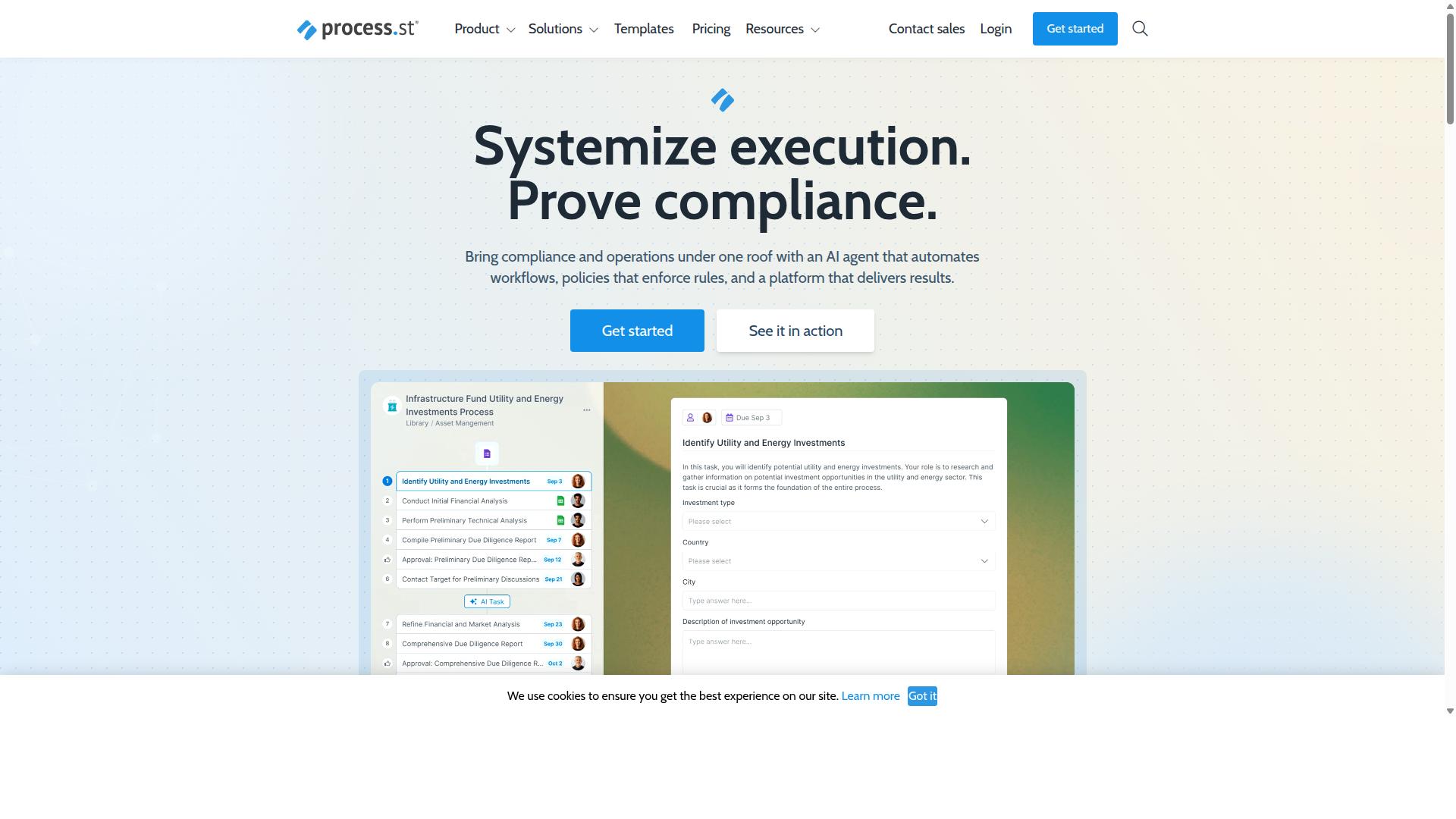
Process Street is a compliance operations platform that automates business processes and enforces policies across distributed teams. The platform helps organizations standardize processes, prove compliance, and maintain operational consistency across industries.
Users create workflow templates that define each step of a process. These templates can include conditional logic to route tasks based on specific conditions or data inputs.
The form builder allows teams to collect structured data during process execution. Information captured through forms feeds into downstream steps and decision points.
Process Street includes AI-enhanced routing through Cora, an AI compliance and risk agent. This agent helps manage risk and maintain compliance within automated workflows.
The platform offers three main products: Docs for document management and policy control, Ops for workflow automation and process orchestration, and Cora for AI compliance and risk management. These products work together to deliver audit-ready proof for regulated business processes.
What Is Appian?
Appian is a low-code BPM suite primarily used by large enterprises for case management and enterprise workflow. The platform helps organizations handle complex business processes through visual design tools and structured automation capabilities.
Many enterprises choose Appian when they need business process management across multiple departments and systems. The platform supports process orchestration and includes tools for managing workflows at scale.
Appian provides API connectivity options that allow connections with existing enterprise software. Organizations often use these capabilities to link different systems and maintain data flow between applications.
Key capabilities include data mapping features, user permissions controls, and audit trails for compliance requirements. The platform supports various authentication protocols and includes options for data validation during process execution.
Enterprises in regulated industries often consider Appian when they need security compliance features such as GDPR support and SOC 2 certification. The platform provides tools for maintaining data lineage and tracking process activities across systems.
Features Compared
This section evaluates three core integration capabilities side-by-side.
Process Street provides specific workflow automation, API connectivity, and compliance controls for data integration scenarios. Appian offers a general BPM platform with integration features that vary across deployments.
| Feature | Process Street | Appian |
|---|---|---|
| Workflow Automation | AI-powered workflows, conditional branching, role-based task assignment | Process orchestration with conditional logic varies by implementation |
| API Access | REST endpoints, Salesforce, Slack, Zapier connectors, OAuth 2.0 | Custom API development required for most external connections |
| Compliance | SOC 2 Type II, ISO 27001, regional data residency options | Compliance features depend on deployment configuration and add-ons |
Workflow Automation & Data Orchestration
Process Street turns static policies into AI-powered workflows that execute tasks and pass data across systems without manual handoffs.
Conditional branching for approval flows allows users to route tasks based on specific criteria such as request amounts or department types. This automation eliminates delays that occur when manual decisions are required.
Role-based task assignment ensures the correct team members receive work items based on their job functions. This approach prevents bottlenecks when team structures change or when multiple people share the same responsibilities.
Data mapping from CRM records into workflow variables transfers customer information directly into process steps. This mapping reduces duplicate data entry and maintains consistency across different business systems.
API Access & Data Set Management
Process Street exposes REST endpoints and pre-built SaaS connectors that let teams pull or push records between systems in minutes.
Teams connect with Salesforce to sync customer records, Slack for notification workflows, and Zapier for extended automation options. These connectors support common business use cases without requiring custom development work.
The platform includes OAuth 2.0 authentication, error handling mechanisms, and rate-limit controls. These security features protect data during transfer and maintain stable connections between different systems.
Public API access enables custom integrations when pre-built connectors do not meet specific requirements. This flexibility supports organizations with unique technical needs or legacy system connections.
Compliance & Audit-Ready Data Governance
Process Street logs every data change with timestamps, user IDs, and field-level lineage, satisfying SOC 2 Type II and ISO 27001 requirements.
Audit trails capture all workflow modifications, data updates, and user actions throughout each process. These records support regulatory reviews and internal compliance audits without additional setup.
Role-based permissions control which team members can access, modify, or approve specific data within workflows. This permission structure prevents unauthorized changes while maintaining operational efficiency.
Regional data residency options include US, EU, UK, Canada, Australia, and UAE locations. Organizations can select storage regions that meet their data protection and regulatory requirements.
Pricing Compared
Process Street offers three transparent tiers, while Appian pricing is quote-based.
The Startup plan targets new companies with clear limits. This tier supports up to 5 users and 10 guests, handles 10 automation apps, and allows 100 automation actions monthly. Data Set records cap at 5,000 with 50 Public API calls permitted each month.
The Pro plan removes most restrictions for growing teams. Custom automation actions and API call limits replace monthly caps, while Data Set records extend to 10,000. User and guest counts become flexible based on team size needs.
The Enterprise plan adds dedicated support and advanced capabilities. Custom Data Set records, unlimited Public API access, and a Success Manager become available. Additional services include bulk document import and process consulting.
Appian pricing requires direct sales contact for quotes. This approach makes direct cost comparison difficult without engaging their sales team first.
Process Street's fixed pricing allows teams to budget accurately from the start. The clear structure helps organizations evaluate data integration costs upfront rather than navigating custom quotes.
Who Should Choose Process Street
Teams needing fast, no-code integration and audit-ready workflows will benefit most from Process Street. This option works well for organizations that want to connect multiple systems without heavy IT involvement. IT teams managing 10+ SaaS tools often find this approach saves time during daily operations.
Ops Managers in financial services need reliable data flows between systems. Process Street supports these needs through its focus on compliance and audit trails. The platform handles workflows that require strict documentation and approval processes.
HR leaders standardizing onboarding across departments benefit from consistent data handling. Employee onboarding use cases include client onboarding, ISO compliance, and quality tracking. These processes require accurate data transfer between HR systems and other business tools.
Process Street serves industries including healthcare, real estate, and manufacturing. Customer management teams use the platform to maintain data consistency across different departments. The solution connects operations, finance, and compliance functions through standardized workflows.
Document control requirements in professional services and capital markets create demand for traceable data movement. Process Street addresses these needs through its workflow automation capabilities. IT and security teams can implement these solutions while maintaining oversight of data access and permissions.
Who Should Choose Appian
Large enterprises with complex case-management and heavy on-premise system needs may gravitate toward Appian. This BPM platform handles intricate regulatory requirements and legacy infrastructure requirements. Organizations facing strict compliance mandates often find its architecture suitable.
Appian supports extensive data integration across multiple systems. Teams can connect to existing databases and enterprise applications through established protocols. The platform accommodates both cloud and on-premise deployments for mixed environments.
However, implementation complexity increases with scale. Teams typically require dedicated technical resources and extended setup periods. Maintenance overhead grows alongside system sophistication over time.
Smaller organizations and teams seeking rapid deployment may encounter practical barriers. The learning curve demands significant investment in training and ongoing support. Resource allocation becomes a critical factor when evaluating this option against alternatives.
Process Street competes in this space by offering streamlined setup for teams focused on workflow automation and data connectivity. Organizations prioritizing quick implementation find simpler interfaces reduce the time from purchase to active use. This approach addresses common pain points around deployment speed and resource requirements.
Final Verdict
Process Street delivers faster integration, clearer pricing, and stronger compliance tooling for growing teams. Teams evaluating data integration solutions often find these three factors decisive when comparing Appian to Process Street.
Process Street provides faster documentation than standard alternatives. This speed helps teams maintain accurate records without slowing down their core work. Faster documentation also reduces the risk of errors during data migration projects.
Setup time drops when organizations choose Process Street over traditional BPM platforms. The reduced setup time means teams can focus on actual data integration rather than configuration overhead.
More than one million users already run Process Street in production environments. This user base spans organizations of varying sizes, demonstrating the platform's reliability for different data integration scenarios.
Teams ready to evaluate their next data integration platform can contact sales directly. Support is available through email and chat with an average response time of five minutes and a 98 percent customer rating. Process Street also appears on AWS Marketplace for easy discovery and procurement.