 thefranchisefacts.com
Reminderly.ai vs Tasks.Bot for Real Time Trigger Automation Software
Real-time task triggers fail when your team never opens the app. If assignments, deadline reminders, and field updates live in a tool nobody checks between jobs, work stalls until someone follows up manually. That gap costs hours every week.
This comparison breaks down how Tasks.Bot handles real-time trigger automation through WhatsApp, from voice notes and natural language AI to GPS tracking and face-verified attendance. You will see how it stacks up against Reminderly.ai, what the free trial includes, and which teams get the most from it.
What Is Tasks.Bot? WhatsApp-Native Task Management With Real-Time Triggers
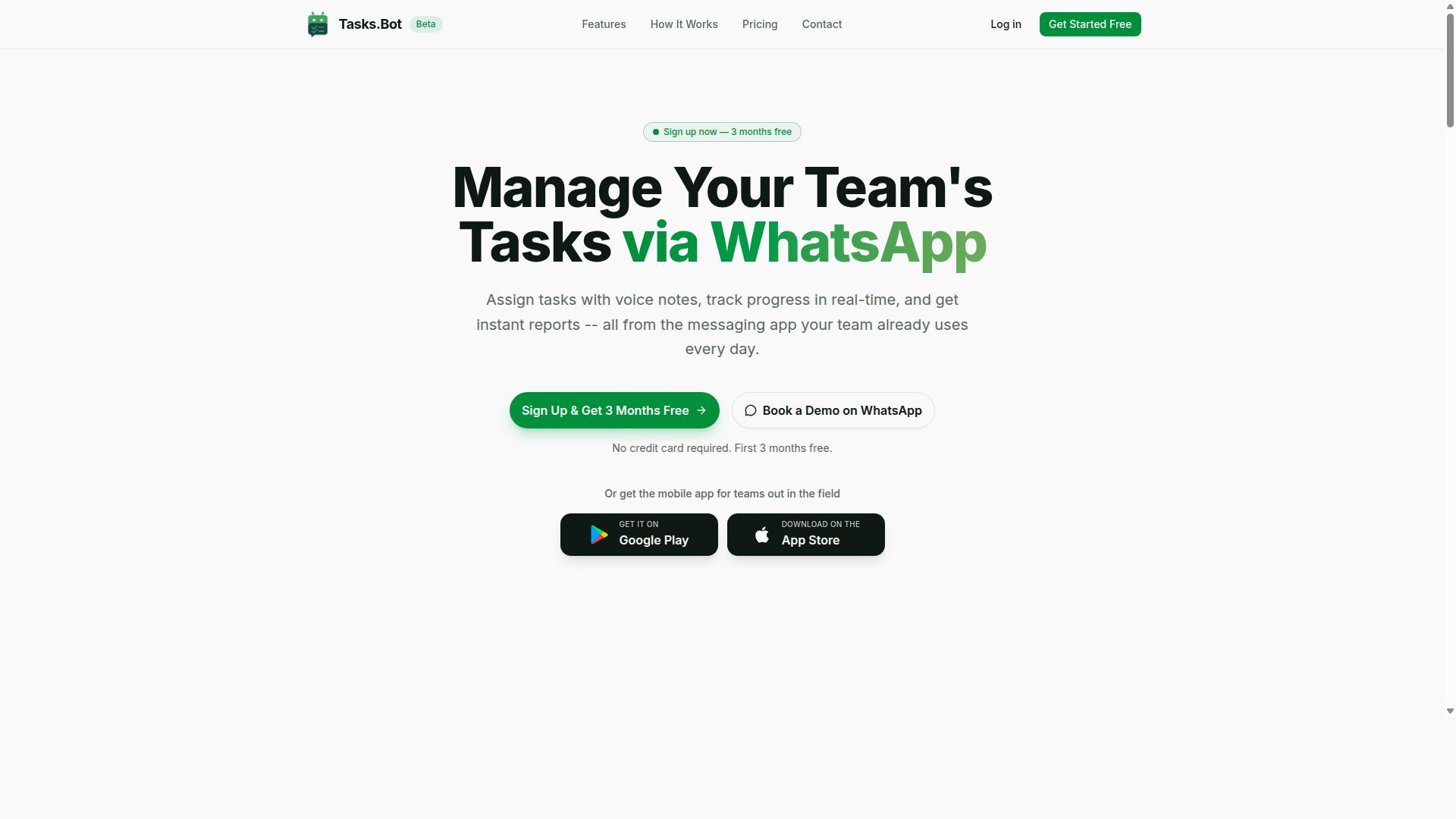
Tasks.Bot is a task management platform that operates entirely within WhatsApp, enabling teams to assign tasks, track progress, and receive reports without leaving the messaging app. Instead of asking employees to learn another dashboard, it turns a tool they already use every day into the workspace itself.
That design choice matters for real-time trigger automation. Because messages, voice notes, and replies all flow through one familiar channel, trigger-based actions can fire the moment something happens, not hours later when someone remembers to update a board. The platform also offers a mobile app for field teams, so workers away from a desk stay connected through push notifications, voice capture, and a home screen widget.
Key capabilities include:
- Voice note task creation
- Automatic task assignment
- Smart deadline reminders
- Approvals and automations
- Instant reports and tasks on a map
- Live day tracker and face-verified attendance
- Shifts, leave, and hours management
Tasks.Bot uses AI to understand user intent and create tasks from messages, which is what separates it from a plain group chat. There is no new app installation or account required for team members, which removes the biggest barrier to adoption in field and frontline teams. The service is currently in beta and offers a free trial period, so teams can evaluate the WhatsApp automation workflow before committing.
How Tasks.Bot Handles Real-Time Trigger Automation
Tasks.Bot leverages real-time triggers to automate task creation, assignment, and reminders based on events and user actions within WhatsApp. Those triggers generally fall into three categories: time-based (such as a deadline approaching), event-based (such as a task being completed), and natural language commands typed or spoken by a user.
The natural language processing layer is where the platform does its most visible work. A team member can send a voice note or a short text message, and the AI interprets the intent and turns it into a structured task. No forms, no dropdowns, no separate interface. This is conversational AI applied to everyday coordination rather than a novelty chatbot.
Once a task exists, automation takes over in several ways:
- Automatic assignment based on predefined rules or AI suggestions
- Smart deadline reminders that adapt to user behavior
- Approvals and automations that route decisions to the right person
Consider two practical examples. A field agent sends a voice note about a broken unit, and that message triggers a task assignment to the nearest technician. Separately, a missed deadline triggers an escalation approval, so a manager is looped in without anyone manually flagging the delay.
What ties this together is that every trigger-based action happens inside WhatsApp. There is no external automation builder to configure, no webhook triggers to wire up, and no additional software for the team to install. For organizations comparing no-code automation options, that simplicity is the core appeal: the workflow automation lives where the conversation already is.
Reminderly.ai vs Tasks.Bot: Which Fits Real-Time Trigger Automation?
When comparing Reminderly.ai and Tasks.Bot for real-time trigger automation, the key differentiators lie in their core platforms, integration depth, and target use cases. One leans on a web-based reminder model, while the other runs natively inside WhatsApp with voice and natural language input. The right pick depends less on feature counts and more on where your team already works.
Reminderly.ai is generally understood as a web-based reminder tool that connects to channels such as Slack and email. Its triggers typically follow a form-based pattern: a user fills in fields, sets a time or condition, and the system fires an automated reminder. That structure suits desk-based teams that live in a browser and want a dashboard view of scheduled tasks.
Tasks.Bot takes a different route. It is a WhatsApp-native task automation tool built around conversational input rather than forms. Users create tasks through natural language and voice notes directly in chat, which lowers the barrier for anyone who finds dashboards cumbersome. Because the trigger happens inside the messaging app people already use, there is no separate login ritual to slow things down.
The comparison below summarizes the practical differences based on publicly available information.
| Factor | Reminderly.ai | Tasks.Bot |
|---|---|---|
| Core platform | Web-based reminder tool | WhatsApp-native task automation |
| Trigger style | Form-based triggers | Natural language and voice triggers |
| Integrations | Reported links to Slack and email | Operates within WhatsApp |
| Input method | Typed fields and settings | Voice notes and chat messages |
| Best fit | Teams preferring web dashboards | WhatsApp-centric teams with field staff |
| Pricing model | Varies by provider plan | Full Access plan, all features included |
Real-time trigger capability is where the two diverge most. Tasks.Bot relies on natural language processing and voice input, so intent recognition happens as the user speaks or types. That matters for field teams who cannot stop to open a laptop and configure a webhook trigger. A spoken instruction becomes a tracked task without leaving the chat thread.
Reminderly.ai, by contrast, appears to depend on structured form entries to define when a reminder should fire. This is reliable and predictable, but it assumes the user is at a screen and willing to complete fields. For event-driven automation tied to quick, on-the-go capture, that model adds friction.
Pricing also shapes the decision. Tasks.Bot offers a Full Access plan with all features included. The monthly plan is ₹200 per member per month, and the annual plan is ₹1,200 per year per member, which saves 50% and ₹1,200 per year per member. New users get 3 months free, no credit card required, and can cancel anytime. Pricing is shown in Indian Rupees and US Dollars, with a currency selector on the site.
Reminderly.ai pricing may differ and should be verified directly, since reminder tools often tier features by seat count or integration level. Buyers comparing a Zapier alternative or IFTTT competitor should weigh whether per-seat costs scale with a large field workforce.
The verdict is scenario-driven. Choose Tasks.Bot if your team coordinates through WhatsApp, includes field staff, and values voice note task creation over form filling. Choose Reminderly.ai if your team prefers a web dashboard and Slack or email reminders, and does not need conversational capture. For WhatsApp-centric operations, Tasks.Bot fits the workflow with less setup friction.
Key Features That Power Tasks.Bot's Real-Time Automation
Tasks.Bot's real-time automation is built on a suite of features designed to streamline task management within WhatsApp. Instead of asking teams to adopt a new platform, the software works inside a messaging app most people already use every day.
At the center of this system is a set of capabilities that turn conversations into action:
- Voice note task creation
- Natural language AI that understands user intent
- Automatic task assignment
- Smart deadline reminders
- Approvals and automations
- Instant reports
These features do not operate as isolated tools. A voice note can become a structured task, that task can be assigned automatically, and the deadline can trigger a reminder without anyone typing a follow-up. This is what makes real-time trigger automation practical for teams that lack the time to manage a separate project management system.
Because Tasks.Bot operates entirely within WhatsApp, team members don't need to install anything or create new accounts. The barrier to adoption stays low, which matters when the goal is fast task initiation rather than another tool to learn. Native WhatsApp integration also means push notifications and updates arrive where conversations already happen.
The sections below break down how these features work together to reduce manual effort and keep tasks moving from trigger to completion.
Voice Notes, Natural Language AI, and Automatic Task Assignment
Tasks.Bot uses natural language processing and voice recognition to turn casual WhatsApp messages into structured tasks. A user can send a voice note the way they would send any other message, and the system interprets the intent behind it.
This is where intent recognition and contextual understanding come into play. The AI identifies action items from ordinary phrasing, such as "Please send the report by Friday." It recognizes that a task exists, who should own it, and when it is due, without requiring a form or a specific command format.
Assignment follows the same logic. Tasks can be routed based on keywords, user roles, or availability. A manager's voice note like "Ask John to fix the leak" can create a task assigned to John with a deadline attached, all from a single spoken sentence.
The practical benefit is a sharp reduction in manual data entry. Instead of opening a tool, filling fields, and assigning an owner, a team member speaks naturally and the task is created. This speeds up task initiation and lowers the chance that a request gets lost in a busy chat thread.
Tasks.Bot also provides Android and iOS apps with push notifications, voice capture, and a home screen widget, so voice-based task creation is not limited to the WhatsApp window alone. Enterprise-grade encryption protects task data, and conversations and task data are never shared or used for training.
Smart Deadline Reminders, Approvals, and Instant Reports
Tasks.Bot automates deadline reminders, approval workflows, and reporting to keep projects on track without manual follow-ups. Smart deadline reminders adapt to context rather than firing on a fixed schedule, so the nudge arrives when it is most useful.
Approvals work inside the same conversation. When a task requires sign-off, approvers receive a notification within WhatsApp and can approve or reject directly, without switching to email or a separate dashboard. This keeps workflow automation inside the channel where the work is already being discussed.
Instant reports close the loop. Tasks.Bot can generate real-time summaries of task status, completion rates, and team performance, delivered through WhatsApp or email. A manager can see how a field team is progressing without chasing individual updates.
Consider how these pieces connect in daily use:
- A reminder reaches an assignee shortly before a deadline
- An approval request for a purchase order goes to the right approver in WhatsApp
- A daily report summarizes field team tasks for the manager
Together with features like tasks on a map, a live day tracker, face-verified attendance, and shifts, leave, and hours management, these automations cover both office and field workflows. Tasks.Bot offers a 3-month free trial with no credit card required, so teams can evaluate the full feature set before committing.
Field Team Automation: Live GPS, Face-Verified Attendance, and Day Tracking
Tasks.Bot extends its automation capabilities to field teams with live GPS tracking, face-verified attendance, and day tracking features. These tools are built for teams that already run their daily communication through WhatsApp, especially those managing field staff who need task management, attendance tracking, and payroll-ready hours in one place.
Instead of treating location, attendance, and task progress as separate systems, Tasks.Bot connects them into a single real-time trigger automation flow. A check-in can set a task in motion. A location change can fire a trigger-based action. The result is less manual coordination and more event-driven automation doing the busywork.
Live GPS tracking shows the real-time location of field staff on a map. Dispatchers and managers can see who is where, which makes it easier to route the nearest person to a job or monitor coverage across a service area.
Because the location data feeds into the same system that holds tasks, proximity itself can act as a trigger. When an agent arrives near a client site, a location-based task can surface automatically. This is event-driven automation applied to physical movement, not just digital events.
Face-verified attendance uses facial recognition to confirm check-ins. This reduces buddy punching, where one worker clocks in for another, and gives managers a more trustworthy attendance record.
The attendance log also feeds payroll. Since the brand positions Tasks.Bot for teams that need payroll-ready hours, verified check-ins and check-outs translate directly into cleaner time data at the end of a pay period.
Day tracking logs start and end times along with task progress throughout the day. Managers get a running view of what each field agent has completed, what is still open, and how the day is pacing.
This matters for workflow automation because a field agent's check-in can trigger task assignment. The moment attendance is confirmed, relevant tasks can be routed to that person without a dispatcher manually creating and sending them.
Combined, these three features support a simple loop:
- An agent checks in with face verification.
- Live GPS confirms their location on the map.
- Day tracking logs the start time and task progress.
- Check-in and proximity events trigger task assignment.
All of this is available through the mobile app and WhatsApp. That matters for field teams because WhatsApp automation meets workers where they already are, rather than forcing them onto a desktop tool they rarely open during a shift.
For teams evaluating task automation software for field operations, the appeal is the connection between presence and action. Attendance is not just a record. It is a trigger. Location is not just a dot on a map. It can be a condition that starts a task. Day tracking is not just a timesheet. It is a live view of progress.
Tasks.Bot serves hundreds of teams already using the service, and its field features fit the same pattern as the rest of the platform: capture an event, then let automation handle what happens next. For field staff on WhatsApp, that means fewer manual handoffs and a clearer record of the workday from first check-in to final task.
Pricing and Plans: Full Access With 3 Months Free
Tasks.Bot offers a straightforward pricing model with a single 'Full Access' plan that includes all features, available in Indian Rupees and US Dollars. There are no confusing tiers, no feature gates, and no need to guess which package fits your team. Every capability sits inside one plan.
The site presents a 'Select currency' option covering the Indian Rupee and the US Dollar. Readers should verify the currency during checkout so the amount shown matches their preferred billing currency.
| Plan | Price | Billing Basis |
|---|---|---|
| Monthly | ₹200 per member per month | Billed each month |
| Annual | ₹1,200 per year per member | Billed once a year |
The annual plan works out to 3 months free compared with paying monthly across a full year. For a team of several members, that gap adds up quickly, and it is the simplest way to lower the per-person cost.
New users also receive 3 months free, with no credit card required and the option to cancel anytime. That combination makes it easy to evaluate the platform before committing budget.
What does Full Access actually cover? The plan bundles the complete feature set rather than splitting tools across paid levels, including:
- Voice note task creation
- Automatic assignment
- Smart reminders
- Approvals
- Instant reports
- Field team tools
For teams comparing task automation software, this matters. Features like smart reminders and automatic assignment sit at the center of real-time trigger automation, so having them included by default removes a common source of hidden cost.
Tasks.Bot is currently in beta, and a refund policy is mentioned in the footer of the site. Checking that policy before purchase is a reasonable step for any buyer, and it is easy to find.
To see how the plan fits your workflow, readers can book a demo on WhatsApp and get started from there.
Trust Signals: Beta Status, Encryption, and Teams Already Using It
Tasks.Bot is currently in beta, but it already powers hundreds of teams and employs robust security measures including encryption. That combination tells you something useful about where the product stands today. It is not an abandoned experiment, and it is not a finished platform either. It sits in the middle, actively maintained and already trusted in production environments.
For buyers comparing real-time trigger automation options, beta status deserves a straight explanation rather than a sales spin. Here is what it means in practice, and why the other trust signals matter just as much.
What beta status actually signals
A beta label usually means two things at once. First, the team is still shipping changes, which is often a good sign for a workflow automation product. Real-time systems depend on integrations staying current, and active development supports that.
Second, some features may evolve over time. Interfaces can shift, behavior can be refined, and documentation may lag behind the latest release. That is normal for software in this stage, and it is worth planning around.
The practical takeaway: beta is a reason to test your most important trigger-based actions before rolling them out widely. Start with a small team or a single workflow, confirm it behaves the way you expect, then expand. This approach costs little and removes most of the risk that comes with any early-stage platform.
Transparency matters more than the label itself. A vendor that states its beta status openly is easier to trust than one that hides it.
Encryption and data protection
Tasks.Bot uses enterprise-grade encryption to protect data. In plain terms, that covers two distinct moments: data moving between your systems and the platform, and data sitting stored on the platform's servers.
Why does this matter for event-driven automation? Because these tools touch sensitive material by design. A workflow might carry customer names, order details, internal messages, or calendar entries. Every one of those is a piece of business data moving through a third party.
- Encryption in transit protects data while it travels between services
- Encryption at rest protects stored data on the platform side
- Both layers reduce exposure if something goes wrong in between
No security setup removes every risk, and no responsible vendor claims otherwise. What encryption does is establish a baseline that serious buyers should expect before connecting business systems to any no-code automation tool. Tasks.Bot meets that baseline.
Hundreds of teams already using it
Adoption is its own kind of evidence. Tasks.Bot already powers hundreds of teams, which means the platform is handling real workloads, not just demo scenarios. For a product still in beta, that level of usage is a meaningful signal.
Social proof matters most in a category where reliability is hard to judge from the outside. You cannot easily inspect someone else's API integration or webhook triggers before signing up. Knowing that other organizations have already committed to the platform fills part of that gap.
It also suggests the team is supporting live customers, not just building features. Support load, bug reports, and integration edge cases all shape a product quickly once real users arrive.
A reasonable way to read this: hundreds of teams is not the same as thousands, and it should not be treated as a guarantee. It is simply a stronger position than a brand new tool with no users at all.
Global access through WhatsApp and mobile apps
Tasks.Bot is a global service, reachable through WhatsApp automation and mobile apps. That matters because automated reminders and approvals often need to reach people who are not sitting at a desk.
WhatsApp is one of the few channels with genuinely worldwide reach. Building on it means a chatbot automation flow can reach a field team, a contractor, or a client in a region where email habits are inconsistent.
Mobile access supports the same goal from the other direction. A manager can review a pending action or confirm a trigger without opening a laptop. For time-sensitive push notifications, that difference is often the whole point.
The site also offers a Book a Demo on WhatsApp option, which fits the same pattern. You can evaluate the platform through the channel it is built around, rather than through a form and a scheduled call.
This global, chat-first approach is a trust signal in a quieter way. It shows the product was designed for distributed teams from the start, not adapted for them later.
The refund policy as a risk buffer
The site mentions a refund policy in the footer. That detail is easy to overlook, but it changes the decision math for anyone hesitant about beta software.
A refund policy means the downside of trying Tasks.Bot is bounded. You can test your workflow automation use cases, see how the platform handles your actual volume, and make a decision based on results rather than promises.
Combined with the other signals, the picture is fairly clear:
- Active development, since the product is in beta and still changing
- Encryption for data protection
- Hundreds of teams already running workloads on the platform
- Global reach via WhatsApp and mobile apps
- A published refund policy that limits financial risk
None of these points is a guarantee of perfection, and beta software will always carry some uncertainty. What they add up to is a platform that is open about its stage, protective of your data, already in use by real teams, and willing to stand behind a refund. For an AI scheduling assistant or task automation software decision, that is a reasonable foundation to build on.
Who Should Use Tasks.Bot for Real-Time Trigger Automation
Tasks.Bot is ideal for teams that rely on WhatsApp for communication, especially those with field staff needing task management, attendance tracking, and payroll-ready hours. The platform is built around the tools these teams already open every day, so adopting it does not mean learning a new system from scratch.
According to the brand, hundreds of teams already use the service. That audience is not random. It points to a specific type of operation: mobile-first, message-driven, and focused on getting work assigned and confirmed quickly rather than managing complex projects.
If your staff spends more time in a chat thread than in a dashboard, Tasks.Bot fits the way they already work. If your team needs Gantt charts and resource leveling, it probably is not the right match.
Small and medium businesses are a natural fit. These companies rarely have the budget or the patience for heavy task automation software that requires weeks of setup. A WhatsApp-based workflow means the tool lives where the conversation already happens, and real-time trigger automation can fire off an assignment or a reminder the moment a condition is met.
Field service teams are another strong match. Maintenance crews, delivery drivers, and outside sales reps are rarely sitting at a desk. They need trigger-based actions that reach them on a phone, not a desktop notification they will never see.
Consider how this plays out in practice:
- A construction company assigns daily tasks to on-site workers, with each worker confirming completion through the same chat app they use for coordination.
- A sales team tracks client visits, logging each stop as it happens so managers see progress without chasing updates.
- An NGO coordinates volunteers across locations, sending automated reminders when a shift or event is approaching.
Each scenario shares a common thread. The work is distributed, the workers are mobile, and the communication channel is already WhatsApp. Tasks.Bot slots into that reality instead of asking teams to rebuild it.
The reason Tasks.Bot works for these groups comes down to adoption friction. Rolling out new software usually means training sessions, forgotten passwords, and a drop-off in usage after the first week. When the interface is a messaging app people already know, that barrier largely disappears.
Real-time triggers then do the heavy lifting. A task can be assigned, an attendance mark recorded, and hours logged without anyone opening a separate tool. For payroll, that means hours arrive in a form that is ready to process rather than pieced together from memory at the end of the month.
The result is a workflow automation layer that feels less like software and more like a well-organized group chat. Teams that value speed and familiarity over feature depth tend to get the most from it.
Not every team is a fit, and it is worth being direct about that. Tasks.Bot is built for WhatsApp-centric operations, so a team that does not use WhatsApp as a primary channel will not see the same benefit. The value comes from meeting people where they already are.
Teams that need complex project management features may also want to look elsewhere. Dependencies, critical paths, budget tracking, and detailed reporting suites fall outside what a WhatsApp-based task tool is designed to handle. If your workflow depends on those capabilities, a dedicated project platform is the better choice.
Organizations with strict requirements around desktop-first interfaces, or those whose staff simply will not adopt a chat-based tool, should also weigh the decision carefully. The strength of Tasks.Bot is its low-friction, mobile-first design. Teams that do not need that strength will not gain much from it.
For everyone else, the fit is clear. Small and medium businesses, field service crews, remote teams already on WhatsApp, and volunteer coordinators all share the same profile: mobile workers, fast communication, and a need for tasks, attendance, and hours to be captured as they happen. Tasks.Bot serves that profile directly, and hundreds of teams already using it suggest the approach works.
Final Verdict: Is Tasks.Bot the Right Choice for Your Team?
Tasks.Bot stands out as a powerful WhatsApp-native task automation tool, but its suitability depends on your team's communication habits and need for real-time triggers. The platform is built around a simple idea: if your team already coordinates work through WhatsApp, task automation should live there too. That approach shapes both its strongest advantages and its most notable trade-offs.
On the strengths side, Tasks.Bot delivers real-time trigger automation directly inside WhatsApp. Tasks can be created from voice notes, which removes friction for field teams and anyone working hands-free. For teams spread across locations, this combination of conversational input and instant task assignment is genuinely useful.
Pricing is another clear point in its favor. Tasks.Bot positions itself as an affordable option compared to many dedicated project management platforms, which often charge per seat at higher tiers. For small and mid-sized teams, that cost difference can matter as much as the feature set.
That said, the platform has limitations worth weighing. It is still in beta status, which means the product is evolving and some capabilities may change over time. It also relies heavily on WhatsApp, so teams that prefer Slack integration, Microsoft Teams integration, or a Discord bot may find the fit less natural. Compared to full project management suites, advanced features like complex workflows or deep reporting may be limited.
Here is a quick summary of where Tasks.Bot fits best:
- Strong fit: Teams that already run day-to-day coordination through WhatsApp and want fast task creation and tracking
- Strong fit: Field teams that benefit from voice note task creation and real-time assignment
- Weaker fit: Organizations needing extensive third-party integrations or highly complex, multi-stage workflows
- Weaker fit: Teams standardized on Slack, Microsoft Teams, or other messaging platforms
If your team lives in WhatsApp, Tasks.Bot is a practical, cost-conscious choice for real-time task automation and automated reminders. If you need a broader workflow automation platform with wide integration options, it may be worth comparing alternatives before committing. Either way, the decision comes down to how closely your communication habits match the tool's design.
To learn more, you can book a demo on WhatsApp or reach out directly. Contact Tasks.Bot by phone at +91 97143 42522 or by email at [email protected] for additional information.
Frequently Asked Questions
What makes Tasks.Bot different from other real-time trigger automation tools?
Tasks.Bot runs entirely inside WhatsApp, so your team doesn't need to install new software or create extra accounts to get started. Tasks are created, assigned, tracked, and reported on right in the chat app your team already uses, with a mobile app also available for field teams. This makes it especially practical for teams with field staff who need task management, attendance tracking, and payroll-ready hours in one place.
How does Tasks.Bot handle task creation and assignment automatically?
Tasks.Bot uses AI to understand natural language and voice notes, so you can create a task simply by speaking or typing it as you normally would. Tasks can be assigned automatically, and smart deadline reminders help keep work on track without manual follow-up. Approvals and automations are built in as part of the platform's feature set.
Can I try Tasks.Bot before committing to a paid plan?
Yes - you can book a demo on WhatsApp directly from the Tasks.Bot website to see how it works for your team. Tasks.Bot is currently in beta, and the site also mentions a refund policy in the footer. This lets you explore the platform before deciding on a plan.
How much does Tasks.Bot cost?
Tasks.Bot offers a single 'Full Access' plan with all features included, so there are no feature tiers to compare. Pricing is available in Indian Rupees (₹) and US Dollars ($): the monthly plan is ₹200 per member per month, and the annual plan is ₹1,200 per year per member, which saves 50%. You can reach the team at [email protected] or +91 97143 42522 with any pricing questions.
Is Tasks.Bot available in my country?
Yes - Tasks.Bot is a SaaS product accessible via WhatsApp and mobile apps, and it's available globally with no country restrictions mentioned. As long as your team uses WhatsApp, you can use Tasks.Bot wherever you're located. Hundreds of teams are already using the service.
Does Tasks.Bot support field teams and attendance tracking?
Yes. Tasks.Bot is designed with field staff in mind, offering tasks on a map, live day tracking, and face-verified attendance. It also provides instant reports and payroll-ready hours, so field operations and reporting stay connected to the same WhatsApp-based workflow. This makes it a strong fit for teams that coordinate field work through WhatsApp.
Recommended Resources: